Wow, what an amazing 2011…did that fly by or what? I’m really thankful for all the great entrepreneurs and investors I had a chance to work with this year. Some truly amazing things going on here. I think 2012 will be even better!

So happy holidays to you and yours. And, as is my tradition, I leave you with my all-time favorite holiday card / greeting from Blueprint Ventures back in 2006. Patayto, Patahto. LOL.

Share and Enjoy:
  • Digg
  • StumbleUpon
  • del.icio.us
  • Facebook
  • Twitter
  • Google Bookmarks
  • HackerNews
  • LinkedIn
  • Reddit
  • PDF
  • email

Repost from http://extensionengine.com/

Flash for mobile is dead. Can Flash for desktops be far behind?

That is the big question facing hundreds of thousands of websites after Adobe, maker of the most popular technology for web video and other interactive multimedia features, said earlier this month it would no longer support Flash on mobile browsers, ceding to the newer, feature-rich HTML5 technology that works – and performs better – on most mobile devices.

For years, Flash has enjoyed a monopoly that is comparable to Microsoft in the past and Google now. Just consider the following, advanced by Adobe itself but citing independent companies such as Forrester, Alexa and ComScore:

  • 85% of the top 100 websites used Flash;
  • 75% of web video is played on Flash players;
  • 98% of PCs connected to the Internet have Flash players;
  • 98% of enterprises use Flash to deliver videos;
  • 70% of games are delivered using Flash
  • Developer community of 3 million

Even though Flash remains near ubiquitous on PCs, web developers such as Robert Accettura give the technology a life of no more than 24-36 months. Some others such as Robert Reinhardt, founder of VideoRx.com, believe the transition to HTML5 technologies will be “slow” but “inevitable,” with the latter the operative word.

If history is any guide, technology change typically occurs more rapidly than we ever realize. In about 18 months since Apple’s Steve Jobs mounted the first serious opposition to Flash’s monopoly – refusing to include the technology in Apple’s iPad or iPhone – HTML5 has soared in popularity and emerged as a consensus technology by biggies such as Microsoft and Google. Just look at the figures below:

  • 34% of the 100 most popular websites used HTML5 in the quarter ended September, according to the blog binvisions.com.
  • By 2016, 2.1 billion devices will have HTML5 support, according to ABI Research Data.
  • Dice.com, the tech job site, has found that resume searches for HTML5 expertise more than doubled between the first and the third quarters.

If anything, HTML5 adoption will likely accelerate, ironically because of Adobe’s abandoning Flash for mobiles.

Given the situation, what are companies and IT heads to do?

As many have pointed out, the current period is one of transition in which web developers will have to work with multiple formats. Some believe HTML5 still lacks some features such as full-screen rendering that is so exciting on a desktop or laptop, or streaming out-of-the-box. Still, many will want to progressively convert from Flash to HTML5 in order to deliver their content. Also, companies can, and should, decide when and how to manage this transition, and when to dive headlong into HTML5. These are tricky decisions critical to the enterprise but those that nevertheless need to be taken at the right time.

Share and Enjoy:
  • Digg
  • StumbleUpon
  • del.icio.us
  • Facebook
  • Twitter
  • Google Bookmarks
  • HackerNews
  • LinkedIn
  • Reddit
  • PDF
  • email

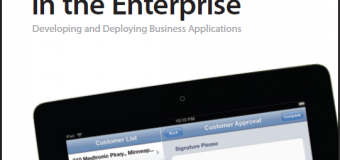
Yesterday I finally received and read iPad in the Enterprise that I had pre-ordered a while ago.

If you’re involved in enterprise mobile whether it’s C-level strategy or implementation for a business unit, this book is worth a read. In truth, this book is really two books in one. The first seven or eight chapters are written for the CIO. The author, Nathan Clevenger, writes about the evolution of iOS and how enterprise IT has influenced it, the “consumerization” of IT, developing an enterprise mobile strategy, build vs. buy, etc. You can tell Clevenger interviewed a lot of people for the book and covers a lot of ground in these first chapters without diving too deep.

One of my favorite bits in the first chapters is Clevenger recounting an interview with Geoffrey Moore (of Crossing the Chasm fame) about how the technology adoption curve he theorized is affected by the consumerization of IT generally and the the iPad specifically. The response (which I think could be expounded into an entire book itself) was that it blows up the curve. The whole idea of early adopter and mainstream and laggards goes away with things like the iPad because it is so intuitive and easy to use. Grandmothers (traditional laggards) and nerds (early adopters) are adopting the iPad at the same time.

Not surprisingly, the biggest take-away of the strategy chapters of iPad in the Enterprise is defining and understanding the business metric(s) you want to improve and then working to build a team and plan to achieve that. Technology for the sake of technology is to be avoided.

On the topic of build versus buy, Clevenger offers a strategy of see-if-you-can-buy-before-you-build. There are probably 50 pages of the book dedicated to a review of dozens of applications that address various enterprise problems (from content management, to communication, to sales automation). With hundreds of thousands of apps in the app store, it’s hard to find fault with the advice of buy before you build. On the flip side, Clevenger points out that the apps themselves can be a small fraction of the overall cost (if you integrate with internal enterprise systems). This is not a warning, but rather a reminder to consider the total costs…a topic that I want to address in more detail in a future post.

In the second half of the book, Clevenger and his co-authors dive into the details of iPad application design and deployment. He touches on the entire development process from initial UI design through build, test and deploy. Probably the most important bit is the focus on what Apple has already defined in their Human Interface Guidelines. To understand design for iOS you really need to start with Apple’s HIG. Clevenger spills much ink on this topic, all of it warranted.

Then this is where the book gets into the weeds…to the point where there are pages with sample code. While it might be worth a CIO skimming these latter chapters, they’re really written for the IT professional and product managers implementing or considering implementing iPad applications in their company. There are many real design nuggets…one of my favorite is on the topic of data security and how to avoid users “capturing” data using the native screen capture functionality (hint: you can’t turn it off, but you can thwart it).

So all-in-all, iPad in the Enterprise is a well written, timely and informational book which we recommend.

Share and Enjoy:
  • Digg
  • StumbleUpon
  • del.icio.us
  • Facebook
  • Twitter
  • Google Bookmarks
  • HackerNews
  • LinkedIn
  • Reddit
  • PDF
  • email

I wrote this post, the full version of which is over at extensionEngine.

Every year since 2005 has been declared (in advance) the “year of enterprise mobile” however not until 2010 was that prediction correct.  And the catalyst for that was the introduction of the Apple iPad (and subsequently similarly featured tablets on other OS’s) which is now being tested or deployed by 65% of the Fortune 500.  And this isn’t just theoretical for us.  extensionEngine has been developing mobile applications since the firm was founded in 2000 and in the past year we have seen explosive growth, particularly in iOS and for the iPad (but also to a lesser degree for Android devices and RIM). So we thought we’d share our top 10 tips on developing mobile applications for the enterprise:

10. Make sure you really need it.  First of all, make sure the app doesn’t already exist!  After that, check to see if an app is the right way to do it.  For the vast majority of use cases, it’s easier, cheaper and faster to develop an HTML 5 version of the current online website specifically for mobile.  You only need a native app if you require access to device specific controls or inputs; for example GPS location data, accelerometer data, multi-touch screen, camera, working offline, etc.  If you’re just pushing reports to your sales force in the field, you can do that with a HTML 5 site.  But if you want to show a map of your sales rep’s customer accounts within a few miles of her current location filtered for those that are large but haven’t had a recent touch and make the experience interactive…you’re going to want to do that in a native app.

Read the rest of the post here.

Share and Enjoy:
  • Digg
  • StumbleUpon
  • del.icio.us
  • Facebook
  • Twitter
  • Google Bookmarks
  • HackerNews
  • LinkedIn
  • Reddit
  • PDF
  • email

I hadn’t heard of Hatsune Miku until having lunch last week with NetProspex CEO Gary Halliwell who told me about this singing synthesizer program with a 3D hologram and concerts.  But I didn’t get it until he pulled out his iPhone and showed me this Youtube video (with 7 million page views!):

There are so many cool things about this. First, think of a Lady Gaga level popular “rock star” without a rock star! Imagine putting on a concert with no COGS (cost-of-goods-sold)! Plus you could put on 10 concerts at the same time across the country. The music industry has been complaining about their model being eroded by piracy, but it would seem that innovation like this could transform the industry.

Imagine if someone took this technology and used it to put on Elvis concerts or Jimmy Hendrix? Or what if you created new virtual artists…like “Lady Madonna”…

BTW, Hatsune Miku is playing “her” first US concert on July 2, 2011 in California and the tickets are sold out!

Share and Enjoy:
  • Digg
  • StumbleUpon
  • del.icio.us
  • Facebook
  • Twitter
  • Google Bookmarks
  • HackerNews
  • LinkedIn
  • Reddit
  • PDF
  • email

Do for cable what they did for mobile.

But let’s step back a minute first.  It’s almost hard to remember what mobile was like before 2007 when Apple introduced the iPhone.  It was not just the hardware and software that was cumbersome and poorly designed.  The ecosystem was also screwed up.  If you recall, it was the carriers who controlled the “deck” (in the US at least).  A startup that could get their app onto the Verizon deck and installed on the handset at the time of sale could expect a bump in valuation close to $100 million.  But of course, all the carriers were extracting huge fees for the privilege of letting customers use your software.  So to my mind, the best things Apple did for mobile were (in this order):

  • Create the App Store and a way for developers to get lots and lots of applications on the iOS deck.  Yes, developers still complain about how Apple is a bottle neck for getting apps approved and that they’re “looking for ways to extract more money” but these moves pale in comparison to the olden days.
  • Launch a great handset in the iPhone.  IMHO the iPhone is the best handset before or since it’s launch. Others come close now (Android essentially copied Apple) but I think the iPhone is really great.
  • The iPad. As my good friend Steve Murray at Softbank says, “Every year since 2005 has been the year of enterprise mobile”.  But I think 2011 really is it.  It wasn’t until the iPad was introduced in 2010 that enterprise mobile could begin to deliver upon it’s vision.  The form factor, screen size and battery life all combined with an easy to use iOS interface, make the iPad the perfect mobile solution for enterprises.  And businesses see this.  Apple’s CFO said on a recent call with investors, that 90% of the Fortune 500 were testing or deploying the iPad.

So basically what Apple did for mobile is truly transformational and you ask, what could top that?   I say revolutionize cable.  Anyone with cable at home will tell you that the hardware (the cable box) is a piece of shit.  The remote sucks (all 4 of them!).  The integration with the TV is terrible.  When it comes to content, it’s very limited and prices are high.  The user experience delivered by the software (and hardware) is abysmal.  All of this is because the cable providers (not surprisingly many overlap with the mobile carriers) have a strangle hold on customers and they don’t know how, nor have any incentive to innovate.

I think Apple can, and should, change that.  Apple has dabbled in this area with the Apple TV (now in it’s second version).  The Apple TV is a nice piece of hardware and the user experience works pretty well, but you can tell it’s an incomplete device and ecosystem.  Imagine if Apple were to negotiate with the content providers to get network TV and other channels on Apple TV.  Then open it up to the App Store.  Wow, it could be really amazing.  I think we would see innovation on a huge scale and this could potentially propel Apple to become the first $1 trillion market cap company.  Come on Steve Jobs, let’s do it!

Share and Enjoy:
  • Digg
  • StumbleUpon
  • del.icio.us
  • Facebook
  • Twitter
  • Google Bookmarks
  • HackerNews
  • LinkedIn
  • Reddit
  • PDF
  • email

I’d like to invite you to participate in the 2011 CompStudy, the results of which have become the industry-leading Private Company Compensation and Entrepreneurship Report…the Kelley Blue Book of startup compensation, if you will. To obtain free access to the full reporting platform, the deadline for completion of this year’s survey will be June 30th.

New for 2011:

  • This year’s survey is 10% shorter, and should take approximately 1 hour to complete.
  • Instant access to the 2010 reporting data (including Board data by June 1st)
  • Access to a Company Scorecard – a dashboard-style look at benchmarked compensation data across your executive team
CompStudy Company Scorecard

Sample Company Scorecard

On the right is a screenshot of the Company Scorecard and if you click here you can download a sample. This new feature allows you to get a 1-page snapshot of the company’s management compensation benchmarked against a peer group you select. What’s more, with our proprietary equity and cash indices, the Scorecard gives you an analysis of the overall team compensation and benchmarks that. This feature is available no where else and you get it for free if you participate in the survey!

For a guided video tour of the reporting platform, please visit this page: https://compstudy.com/content/overview

To take the survey, please visit https://compstudy.com

This comprehensive and innovative survey of equity and salary compensation for private companies is produced as a collaborative effort between Professor Noam Wasserman at the Harvard Business School and professionals at J. Robert Scott and Ernst & Young.

Thank you in advance for your time and participation!

Share and Enjoy:
  • Digg
  • StumbleUpon
  • del.icio.us
  • Facebook
  • Twitter
  • Google Bookmarks
  • HackerNews
  • LinkedIn
  • Reddit
  • PDF
  • email

By now most people have heard of Sal Khan and the Khan Academy.  If you haven’t, the following brief video introduction is worth watching, but more importantly you just need to check out one of the 2000 or so videos on the site.

What I love most about what Sal has done is that he started with a tactical problem (how do I tutor my cousins) and through brute force execution turned that into a solution for a truly strategic problem.  His goal is not just to teach kids about math, science and other topics, but rather to become the “operating system for the classroom.”  If you think that mission is crazy, then you have to watch this talk by Sal given a few years ago at the MIT Club of Northern California.  If you watch the bit starting at 17:55 you’ll see Sal’s vision for “flipping the model” and how online, video lectures can become the operating system for teaching.

Check it out.  Amazing!

Share and Enjoy:
  • Digg
  • StumbleUpon
  • del.icio.us
  • Facebook
  • Twitter
  • Google Bookmarks
  • HackerNews
  • LinkedIn
  • Reddit
  • PDF
  • email

Recently I’ve been reading a lot of ink (er, liquid crystal?) on how Google is failing because the search results are becoming decreasingly useful and filled with spam.  This particular post by Marco Arment, founder of Instapaper, caused a firestorm of comments on HN.

But I don’t think that bad search results will be the ultimate demise of Google.  Sure, they’re bad compared to sites like LinkedIN, Wikipedia and the many niche sites focused on a particular topic.  But I don’t see Google users switching en mass thereby depriving Google of it’s “clicks” needed to drive revenue…at least not without Google throwing oodles of money at the problem in an attempt to stem the flow.

There’s something far more sinister that is much more likely to be the downfall of Google and it’s called “click fraud.”  I wrote about this a couple of years ago after a company called ClickForensics put out a press release saying that 17% of CPC ads were click fraud. Last fall, ClickForensics put out their most recent report saying click fraud is now up to 22%!  Applied to the $54 billion global online advertising market, that means there is something like $12 billion in click fraud!  That is the equivalent of a Bernie Madoff sized fraud every year.

Click fraud comes in many forms from the plain vanilla (setting up a website with Google AdSense and then clicking on your own site ads) to the elegant, yet complex, like this scheme described in Forbes.  Google claims they are adequately policing what they call “invalid clicks,” but do we really think they are putting their very best on this?  Remember that Google (and all the other CPC ad driven sites) get 50% of the ill gotten gains.

So, what is the real reason Google is going to fail?  At some point there is going to be an event such as congressional hearings or perhaps a Wikileaks dump that will reveal the true click fraud numbers.  These revelations will do two things: force Google to clamp down thereby eliminating 25% of their revenue and scare the hundreds of thousands of advertisers who use Google into reducing their spend.  Google will see revenue stop growing and possibly even fall and fall sharply.  There will be massive layoffs in successive rounds.  The top technical talent at the company will leave in disgust for greener pastures at Facebook, LinkedIN and elsewhere.  Management will be replaced and all of those free products/services Google offers will be “sunsetted.”

If you don’t think that could happen to an industry giant like Google, remember what happened to AOL.

Share and Enjoy:
  • Digg
  • StumbleUpon
  • del.icio.us
  • Facebook
  • Twitter
  • Google Bookmarks
  • HackerNews
  • LinkedIn
  • Reddit
  • PDF
  • email

Lorem ipsum, that place holder text that you often see in website and other graphic design, has been around since the sixteenth century by some accounts, but became popular in the 60s when Madison Avenue and the golden age of advertising took off.  Its use today in web design, however, is corrupting to the point that it’s become evil.

Do you think Apple uses lorem ipsum?

I can’t tell you the number of websites I’ve seen designed with lorem ipsum (some of those designed by yours truly).  Funny enough, I’ve even seen a few websites go live with some of that lorem ipsum placeholder text still there!  The idea that somehow I need to make a good looking website and then figure out what to say is absurd!  I think a lot of people do this because they (1) don’t know how to do graphic design and (2) they don’t know how to program but they do know how to write (or at least they think they do).  So many folks outsource #1 and #2 and put in lorem ipsum as filler until they themselves can come back after they are done and write the real copy.

So by the time a website creator figures out what they want to say, they already have pretty designs, beautiful buttons, cool interactive charts with nifty forms that all tell half a story that is certainly not aligned.  The end result is either a confusing user experience or a lot of wasted time and money spent fixing it.

I suspect the advent of lorem ipsum was for technical reasons.  Before the age of Photoshop designers would have to actually draw things so it made sense to put in filler text while the actual copy was being worked out.  But today there is no need for that.

So here’s my advice to those planning to build a website.  Start with your message.  Then write a story in words and surround that with whatever the lorem ipsum equivalent of graphics and images is.  Once you’ve nailed your branding, messaging and story to the point where you know exactly the experience you want, only then do you commission expert designers and programmers to manifest your vision.

The last point I’d make on this topic is don’t assume you personally know how to write well.  Most of us don’t know how to do that.  There are really talented writers/branding folks out there who for short money can help you craft a killer story.  In fact, folks who write copy are way cheaper than graphic design folks because the buyers of these services value the latter more.  Think of writers as the equivalent of OBP in the world of Moneyball.

Share and Enjoy:
  • Digg
  • StumbleUpon
  • del.icio.us
  • Facebook
  • Twitter
  • Google Bookmarks
  • HackerNews
  • LinkedIn
  • Reddit
  • PDF
  • email
© 2012 @altgate Suffusion theme by Sayontan Sinha